
What a study of 58 young adults can (and can’t) tell us about vaping, smoking, and cardiovascular risk.
Does vaping harm heart health? Is vaping as harmful as smoking? A new study in https://jamanetwork.com/journals/jamacardiology/article-abstract/2855452 adds some evidence to the debate. Researchers found that young adults who vaped had lower readings on certain blood vessel tests than people who did not smoke or vape. Some readings were similar to those in young adults who smoked cigarettes.
That sounds concerning. But it does not mean vaping and smoking are equally dangerous. Here is what the research can and can’t tell us.
What Did the JAMA Vaping Study Measure?
The study included 58 young adults: 17 who vaped, 19 who smoked cigarettes, and 22 who did neither. It was cross-sectional, which means that they took a snapshot in time.
Researchers checked how much a blood vessel in the arm widened after briefly restricting blood flow with a cuff. Healthy blood vessels can widen to let more blood pass through. The average widening was 8.3% among nonusers, 5.5% among vapers, and 4.4% among smokers.
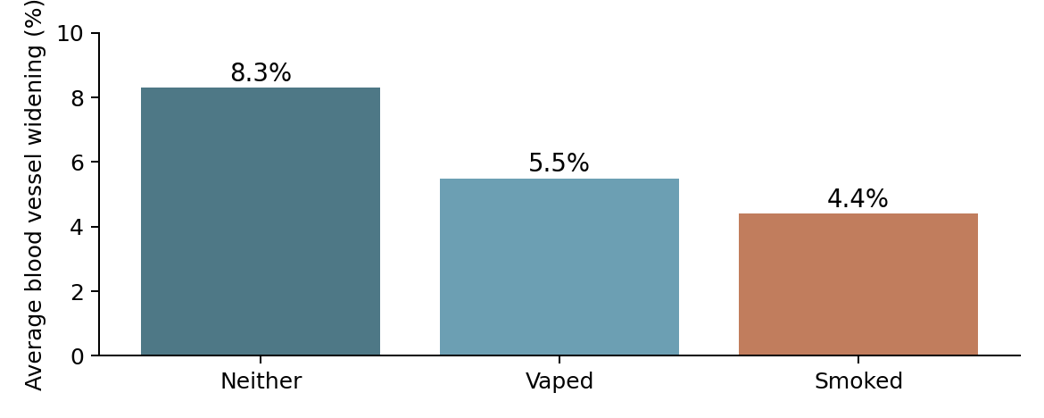
This test gives researchers a clue about blood vessel health. It does not show whether someone has heart disease or predict exactly who will have a heart attack or stroke.
No significant differences were found between the groups on standard lung function tests.
What Are the Limitations of the Vaping Study?
Only 17 participants vaped. That is too few to draw broad conclusions. The researchers also measured people during one period rather than following them for years. This means they cannot prove vaping caused the differences or tell us what will happen to participants later.
The researchers did not fully measure the vaping devices or nicotine levels participants used. And the smokers had relatively short smoking histories. These details make it harder to compare the long-term effects of the two products.
Is Vaping as Harmful as Smoking?
No. Similar results on a few blood vessel tests do not prove two products have the same overall health risks. Cigarettes burn tobacco and expose users to carbon monoxide and many cancer-causing chemicals. The Food and Drug Administration says that “While e-cigarettes can generally be a lower-risk alternative for adults who smoke cigarettes, the use of e-cigarettes is not risk-free.”
What Does the Study Mean for Adults Who Smoke?
Other research cited in the JAMA Cardiology article found improvements in certain blood vessel measures after adults who smoke switched to e-cigarettes.
The study looked mainly at young people who vaped without an established smoking history. It did not test what happens when an adult who smokes switches completely from cigarettes to vaping. We do not sell vapes in the U.S., but many American adults have switched completely from cigarettes to vaping.
Why Nicotine Misperceptions Matter Beyond Vaping
Treating all nicotine products as if they carry the same risks as cigarettes can leave adults with a misleading picture of where the greatest harm comes from. Pouches do not involve burning tobacco or inhaling smoke. Clear communication should distinguish the effects of nicotine from the well-established harms caused by cigarette smoke, while being equally clear that different nicotine products have different evidence bases and risk profiles.
The Bottom Line
Adults who smoke deserve accurate information about cigarettes and other sources of nicotine, including vaping, nicotine pouches, and established quitting treatments. A small cross-sectional study does not prove that vaping is just as dangerous as smoking or that every nicotine product carries the well-known risks of cigarettes.